Showing posts with label sculpture. Show all posts

08/09/2011

28/02/2011

Guillaume Constantin “Un nuage d’incertitudes” 12 03 11 - 29 04 11


show views by Aurélien Mole:


+


"Everyday Ghosts", 2008-2011
veille d'écran / diaporama, 74 photos numériques
5 exemplaires sur clé USB

/
Guillaume Constantin “Un nuage d’incertitudes” 12 03 11 - 29 04 11                                                                                           

28/01/2011

VINCENT MAUGER


«Solutions techniques à des problèmes théoriques» 10 09 11_31 10 11

"Sans titre", extrait de vidéo numérique, 2010 / "Untitled", digital video fragment, 2010

Vernissage: Samedi 10 septembre, 16 - 21h / Opening: Sept. 10, from 4 to 9 pm


-/-

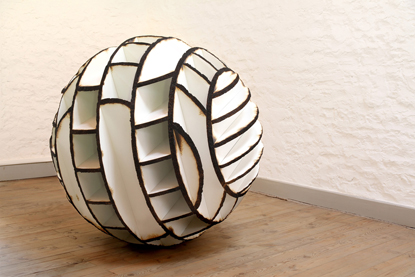
"Sans titre", casiers à bouteille en polystyrène, 2010, 6 x 4,50 x 6 cm. pièce présentée et produite dans le cadre de l’exposition “dynasty” au musée d’art moderne de Paris 
Photo: Pierre Antoine.
courtesy the artist & Galerie Bertrand Grimont


//


NEWS 2011


NEWS 2010


//


Galerie Bertrand Grimont @ FIAC 2010

“sans titre”, 2010, sculpture, bois peint
image courtesy Galerie Bertrand Grimont

/

previous show @ the gallery


“sans titre” , éléments en polystyrène, 95 x 71 x 20 cm, 2008
photo: Aurélien Mole


more on the show...


Aurélien Mole, "up by hole", tirage baryté encadré, 38x45,3 cm, édition de 3 - 
image: Aurélien Mole


diaporama / slideshow:


08/01/2011

Cyril Hatt & Bertrand Planes "Révélations" 01.01 - 26.02.11


Bertrand Planes, "Two artists", one galerist, 2008


"L'univers est rempli d'objets de convoitise qui disparaissent rapidement à nos yeux. Phagocytés par la banalité de l'usage, ils en deviennent transparents. Produits de consommation intégrés au quotidien, ils transitent d'un état à un autre avant de finir au rebut. Leur présence criarde s'amenuise en un bruit blanc.

En scrutateurs du monde, Cyril Hatt et Bertrand Planes choisissent avec soin quelques uns de ces objets avant de leur faire subir un double processus. Par le truchement de l'image, chacun des volumes est dans un premier temps déconstruit. Cyril Hatt saisit toutes les facettes de l'objet choisi, chacune étant contenue dans une photographie de format standard. Fragmenté, l'objet explose et disparait. Bertrand Planes capte la surface du volume et met en mémoire les couleurs, les textures, les aspérités données par le temps. Une fois saisie dans son intégralité, la surface est recouverte de blanc, donnant à la matière une neutralité qu'elle ne possédait pas.

Second mouvement et retour à l'unité : les photographies parcellaires sont réagencées de façon à former le volume initial, couturé aux jointures par des agrafes. Les sculptures de Cyril Hatt sont suffisamment accidentées et déformées pour que l'idée du trompe-l'œil n'effleure personne, reste l'évocation en creux d'un objet devenu sujet. Bertrand Planes donne à ses volumes la possibilité de se réapproprier leur surface d'origine. Recouverts d'une peinture photosensible sur laquelle est projetée leur propre image précédemment captée, ils en deviennent ainsi le réceptacle.

Ni tout à fait les mêmes, ni tout à fait autres, les objets perdent en matérialité ce qu'ils gagnent en évocation. Les images latentes peuvent apparaitre, le réel tangible peut disparaitre, les œuvres de Cyril Hatt et de Bertrand Planes se construisent de ces transmutations."


'The world is filled with objects of desire that quickly vanish before our eyes. Eaten away by the banality of use, they become transparent. Consumer goods embeded in the everyday life, they pass from one state to the other before being discarded. Their loud presence dwindles into a white noise.

Examining the world, Cyril Hatt and Bertrand Planes select a few these objects with great care and submit them to a double process. Through the image, each of these volumes is initially deconstructed. Cyrill Hatt captures all the facets of the chosen object, each of those is contained within a standard format photograph. Fragmented, the object explodes and disappears. Bertrand Planes captures the volume surface and stores the colours, textures and the ruggedness brought by time. Once captured in its entirety, the surface is then covered with white, bringing to the material a neutrality that it did note have.

Second movement and return to unity: the fragmented photographs are rearranged to reconstruct the initial volume, seamed a the edges by staples. Cyrill Hatt's sculptures are rugged and distorted enough to put aside any idea of 'trompe l'oeil', of illusionism, what remains here is an evocation of the object raised to subjecthood. Bertrand Planes gives to its volumes the opportunity to reclaim their original surface. Covered with a photosensitive coating on which is projected their own image previously captured, they thus become their own recipient.

Nor quite the same, or quite other, the objects lose in materiality what they earn in evocation. The latent images can appear and the tangible reality can withdraw, the works of Cyril Hatt and Bertrand Planes are built from these transmutations.'

translation: Samy da Silva


about the show:

@ artslant
@ figaro scope
@ generic
@ marie de paris - yafil
@ parissi
@ slash
...

10/11/2010

JEAN-FRANCOIS LEROY

"Foyer 2", détail, bois et peinture glycérophtalique


//


NEWS 2011
/


//


latest show @ the gallery:


artist @ galerie Bertrand Grimont


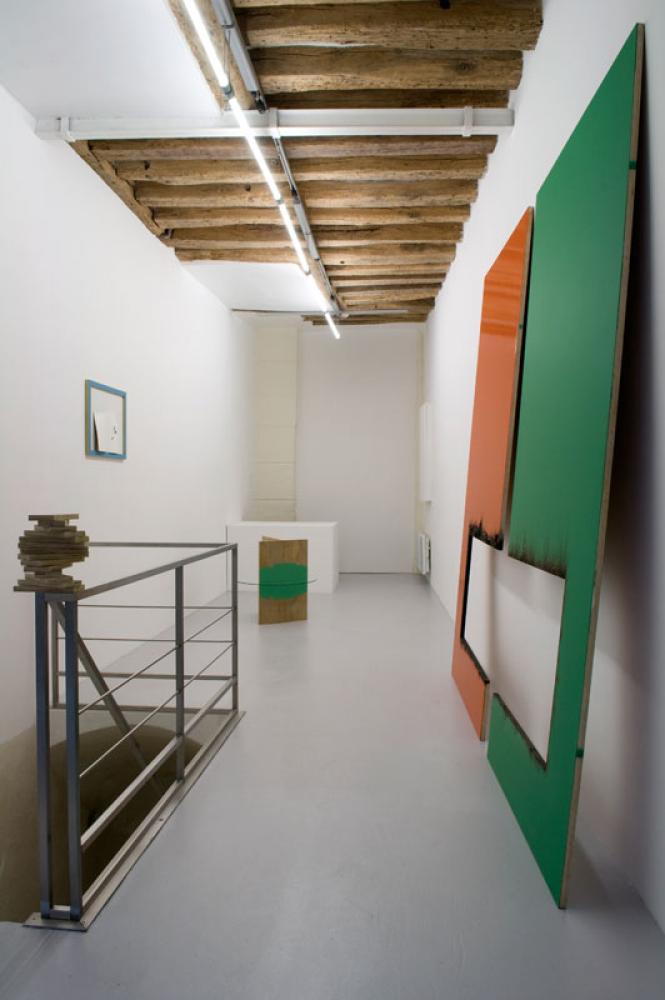
a view from the show
image credit: Aurélien Mole


“Toute pièce exposée ici est inédite – comme on dit, œuvre récente -, mais pour autant pas nouvelle. L’avertissement frise l’absurde, mais c’est bien autour de cet inéluctable attendu de nouveauté, et du paradoxe qu’il peut y avoir à croire que ce qui est neuf est aussi nécessairement original, que Jean-François Leroy a travaillé cet accrochage. Reprenons. L’installation Module/étagère est devenue Etagère modulée. Retravaillée, la pièce n’évoque plus en rien la référence initiale à une table, mais moque toujours cette méprise quant à sa valeur d’usage : entièrement démantelée et réorganisée maintenant sous forme d’étagère d’exposition, sur laquelle s’empilent en bon ordre le reste des composants de la version précédente, à disposition, l’utilisation de matériaux bruts comme une invite à reprendre le jeu de construction.
Jean-François Leroy considère ses réalisations comme autant de matières premières, en tout cas encore utilisables, convertibles, commuables. Des états, dans ce sens qu’on donne aux épreuves qui précèdent la forme que la reproduction va figer, ou plus justement ce moment in progress où l’œuvre n’est qu’un exemple donné d’un vaste éventail de possibles. Car il n’est pas, ici, question de corriger ni d’améliorer ; au contraire, ces transformations successives sonnent comme autant de coup bas à la prétention d’un état définitif. Chaque fois, Jean-François Leroy insiste délibérément sur la dénaturation de la pièce antérieure, juste ce qu’il faut pour que la modification déconstruise la lignée. Cela peut se traduire par des variations de médium – Fond, une photographie couleur à l’échelle 1, recouvrant tout un pan de mur, remplace in situ le store vrillé. C’est aussi ces jeux de combinatoire, ou de fragmentation - une ancienne installation est redistribuée en trois pièces séparées, D’une chose l’autre, Pied, Fenêtre désormais autonomes, chacune réagencée. D’une chose, l’autre, c’est exactement cela : un potentiel infini de correspondances et de déviations, pour mieux perdre de vue ces points limites que sont le modèle et l’idéal.
Remanier, en continu. Jean-François Leroy souligne le caractère évolutif de ses productions. Et cela renforce d’autant cette impression très organique que procure cette façon si particulière de systématiquement ménager des articulations improbables aux objets. Pour gagner en mouvement, pour rompre toute unité, toute continuité : déconstruire, pour contrarier toute stabilité. Somme toute, cette façon de l’œuvre en cours est très proche de l’idée biologique d’un engendrement, comme puissance de génération de signe et de sens. A chaque reprise, une nouvelle donne, bouleversant la précédente. D’une chose, l’autre : Un rectangle de moquette, auparavant utilisé comme tapis de sol, s’érige maintenant en totem - et entre-deux, le basculement vient chambarder l’extraordinaire entêtement que montrent les choses à demeurer en leur état.
Le travail de Jean-François Leroy a cette grande qualité de déjouer la mauvaise habitude qui, en art, consiste à toujours traquer la polarité, c’est-à-dire à vouloir désigner un Plus et un Moins, à réduire toutes relations à des oppositions binaires, et par là obliger à la hiérarchisation. Ici, ni « haut » ni « bas », mais au contraire, dans la transformation, un continuel déclassement des matériaux, des usages, et conséquemment des systèmes de représentation. Et bien sûr, puisqu’on ne peut dire d’aucune des œuvres montrées ici qu’elle est achevée, cet ultime jeu d’avec la valeur marchande : car seule l’acquisition d’une pièce pourrait garantir que sa forme, encore temporaire, devienne fixe.”


Marion Delage de Luget

/ 'Of one thing, the other
Any piece shown here is novel, a recent work as they say, but at the same time it's not new. This warning borders on the absurd, but it's truly around the overpowering expectation of novelty and the paradoxical belief that what is new is necessarily original, that Jean-François Leroy has worked towards this exhibition. Resuming, the 'Module / Shelf' has become 'Modularised Shelf', reworked as it is now, the piece does not evoke anything from the initial reference to a table, but still mocks the mistake about it's use value: it is now entirely dismantled and reorganized as an exhibition shelf on which are orderly stacked the available remaining components of the previous version. The use of raw materials extracted from yards sounds now as an invitation to resume the construction game.
Jean-François Leroy considers its pieces as much raw materials, in any case still usable, convertible, commutable. They are states, in the sense that we give to the trials that precede the form that the reproduction will freeze, or, more precisely, this moment in progress when the artwork is a given sample of a wide range of possibilities. Since there is no question here of amendment or improvement, on the contrary, these successive transformations sound as low blows to the claim of a final state. Each time, Jean-François Leroy deliberately insists on the denaturation of the earlier piece, just enough so that the modification deconstructs the lineage. This may result in medium variations - 'Background', a scale 1 color photograph covering an entire wall section, replaces the warped venetian blind 'in situ'. It is also these combinatory or fragmenting games - an older installation is redistributed into three separated pieces, 'Of one thing, the other', 'Base' and 'Window', now autonomous, each rearranged. On one thing, the other, it's precisely that: an infinite potential of connections and deviations, to better lose sight of these endpoints that are the model and the ideal.
To overhaul, continuously. Jean-François Leroy emphasizes the evolutive trend of its productions and this reinforces the very organic feel that this specific method of systematically arrange unlikely articulations for objects brings. In order to gain in motion, in order to break any unity, any continuity: deconstructing to undermine any stability. Overall, this work in progress approach is very close to the biological notion of the generative, here it is a power generation of sign and meaning. To each new retake, a new deal upsetting the previous one. Of one thing, the other: a carpet rectangle, formerly used as a floor mat, stands as a totem now - and in between, the tilting brings trouble to the extraordinary stubbornness of things to remain in their state.
Jean-François Leroy's work has this great quality to thwart the bad habit that, in art, is to always track polarity, that is to say, to nominate a Plus and Minus, in order to reduce all relations to binary oppositions, and thus compel towards hierarchy. Here, neither 'high' or 'low', but rather, in the processing, a continual downgrading of materials, of uses, and therefore, of the systems of representation. And of course, since we cannot say that any of the works shown here has been completed, a final gameplay with the market value: for only the acquisition of a piece could guarantee that its form, from ephemeral, becomes fixed.'

Marion Delage de Luget
(translation Samy da Silva)

about the show:


°
°


Galerie Bertrand Grimont @ FIAC 2010 / Tuileries


Oeuvres présentées / shown works


“Jean-François Leroy Modules activés 1 et 2 par Claire Taillandier
article & image @ la critique.org


"Jean François Leroy, Module Activé 1, bois, aluminium, affiche, 250 x 120 x 120 cm. Intervention de Benoît Géhanne (affiche). En place jusqu'à mardi matin."

+

Galerie Bertrand Grimont @ FIAC 2010 / stand F16, excerpt:


works by Jean-François Leroy

Guillaume Constantin,
John Cornu,
Vincent Dulom,
Vincent Mauger,
Aurélien Mole,
Jean-François Leroy,
Paul Raguenes


Jean-François Leroy, "sans titre", bois, placoplâtre et peinture, dimensions variables, 2010

Jean-Francois Leroy, vue d’atelier, bois, placoplâtre et peinture, dimensions variables, 2010 (détail)